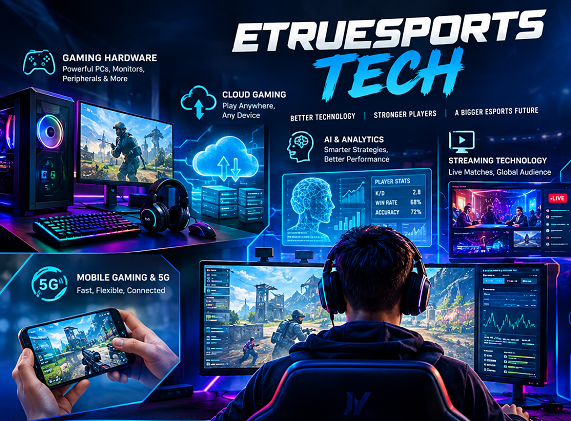

The gaming industry has changed dramatically over the last decade. What was once considered a form of entertainment has developed into a global digital ecosystem involving competitive esports, streaming, game development, artificial intelligence, cloud computing, high-performance hardware, and online communities. At the centre of this transformation is gaming technology, and the term etruesports tech can be used to describe the technology, tools, platforms, and innovations connected with modern esports and gaming experiences.
EtrueSports tech represents the growing relationship between competitive gaming and advanced technology. From powerful gaming computers and responsive peripherals to online tournaments, game analytics, artificial intelligence, and cloud-based services, technology now influences almost every part of the gaming experience.
For players, technology can improve performance and responsiveness. For esports organisations, it can provide better tournament management and player analytics. For audiences, technology makes it easier to watch live competitions, communicate with players, and follow gaming news. This article explores the major areas of etruesports tech and explains why technology is becoming increasingly important in the modern gaming world.
Also Reed: Gaming Etruesports
What Is EtrueSports Tech?
EtrueSports tech can be understood as a broad concept covering technologies used to support gaming and esports. It includes gaming hardware, software, internet infrastructure, streaming technology, artificial intelligence, data analytics, virtual environments, and digital platforms.
The purpose of these technologies is not limited to making games look better. Modern technology can improve game performance, reduce latency, provide useful statistics, enhance broadcasting, support competitive tournaments, and create more interactive experiences for gaming communities.
The concept is particularly relevant to competitive gaming because esports requires a combination of fast hardware, reliable networks, accurate data, skilled players, and professional tournament systems. Even a small technical issue can influence the outcome of a competitive match.
Why Technology Matters in Esports
Technology is one of the foundations of modern esports. Professional players need equipment that responds quickly and consistently. A gaming mouse with accurate tracking, a high-refresh-rate monitor, a responsive keyboard, and a stable internet connection can all contribute to a player’s competitive setup.
However, hardware is only one part of the equation. Behind a professional tournament are servers, matchmaking systems, anti-cheat technologies, broadcasting platforms, statistics systems, and event-management tools.
Technology also makes esports accessible to viewers around the world. A fan can watch a tournament from a smartphone, computer, or smart television without being physically present at the venue. Live chat, social media, statistics, replays, and interactive broadcasts further improve the viewing experience.
Gaming Hardware and EtrueSports Tech
Gaming hardware is an important component of etruesports tech. Competitive players often use specialised equipment designed for accuracy, speed, and comfort.
Gaming PCs
A powerful gaming PC can provide stable frame rates and high graphical performance. Competitive gamers often prioritise consistent performance rather than simply choosing the most expensive components.
Important PC components include:
- Processor (CPU)
- Graphics card (GPU)
- RAM
- SSD storage
- Motherboard
- Power supply
- Cooling system
- High-refresh-rate monitor
A balanced system is important because one weak component can limit overall performance.
Gaming Monitors
Monitors have become particularly important in competitive gaming. High refresh rates can make fast-moving gameplay appear smoother, while low response times can reduce visual delay.
Depending on the game, players may choose monitors with refresh rates such as 144Hz, 240Hz, or higher. The ideal specification depends on the player’s hardware, game, resolution, and competitive requirements.
Gaming Peripherals
Gaming mice, keyboards, headsets, and controllers also contribute to the competitive experience. Players often develop strong preferences for particular shapes, switches, sensitivity settings, and control layouts.
The best equipment is not necessarily the most expensive equipment. Comfort, reliability, consistency, and familiarity are often more important than premium specifications.
Internet Connectivity and Low Latency
Fast and stable internet is another major part of etruesports tech. In online competitive games, latency can affect how quickly information travels between a player’s device and the game server.
Latency, commonly measured in milliseconds (ms), represents communication delay. Lower latency is generally desirable for competitive online gaming.
Internet quality can be influenced by:
- Connection type
- Distance from the game server
- Network congestion
- Router performance
- Wi-Fi interference
- Server capacity
- ISP routing
Fibre-optic connections can provide strong performance for online gaming, but users should also consider stability and routing rather than focusing only on advertised download speeds.
Artificial Intelligence in Gaming
Artificial intelligence is becoming increasingly important across the gaming industry. AI can be used for non-player characters, matchmaking, player analytics, moderation, fraud detection, and game development.
In esports, AI-based analytics can potentially identify patterns in player behaviour. Teams can analyse statistics to understand strengths, weaknesses, strategies, and recurring mistakes.
AI can also assist broadcasters by organising match data and generating useful insights. As these systems become more advanced, AI may become an increasingly common part of professional gaming infrastructure.
Data Analytics and Player Performance
Competitive gaming generates enormous amounts of data. Every match can produce information about kills, deaths, assists, damage, movement, objectives, accuracy, economy, positioning, and other gameplay events.
EtrueSports tech can involve analytical systems that turn this raw information into useful insights.
For example, a team might examine:
| Performance Area | Example Data | Potential Use |
|---|---|---|
| Accuracy | Hit percentage | Improve aiming |
| Movement | Positioning patterns | Improve strategy |
| Objectives | Capture or control rate | Team planning |
| Damage | Damage per round | Player evaluation |
| Economy | Resource usage | Strategic decisions |
| Reaction | Response patterns | Training analysis |
| Match Results | Win/loss records | Long-term evaluation |
Data should not replace player skill or coaching, but it can provide additional information for making better decisions.
Cloud Gaming and Esports
Cloud technology has also changed gaming. Cloud gaming allows certain games to be processed remotely and streamed to a user’s device.
The major advantage is that users may not need extremely powerful local hardware for every gaming experience. However, cloud gaming depends heavily on internet quality and latency.
For esports, cloud technology can also support services such as data storage, tournament management, online infrastructure, analytics, and scalable server capacity.
As internet infrastructure improves, cloud-based gaming services may become more common, although competitive players may continue to prefer local hardware because consistency and latency are extremely important.
Streaming Technology
Streaming has transformed esports from a competition that happens in a physical venue into a global entertainment experience.
Platforms for live video allow audiences to watch tournaments in real time. Modern streaming technology can include:
- Live gameplay
- Player cameras
- Instant replays
- Match statistics
- Live commentary
- Interactive chat
- Multiple broadcast languages
- Real-time graphics
Streamers have also become important figures in gaming culture. They can create communities around games, review updates, explain strategies, and introduce new players to competitive gaming.
Esports Tournament Technology
Professional esports tournaments require sophisticated technology behind the scenes.
Tournament organisers may use digital registration systems, scheduling software, matchmaking platforms, anti-cheat systems, spectator tools, broadcast systems, and statistical databases.
Reliable technology is essential because tournaments often involve many teams, players, matches, and viewers. Automated systems can reduce administrative work and make competitions easier to manage.
For large events, technology also helps organisers monitor matches and respond quickly to technical problems.
Cybersecurity and Anti-Cheat Systems
Competitive gaming requires fair competition. Cheating can damage player trust, tournament credibility, and the overall esports ecosystem.
Anti-cheat technology can monitor game environments and identify suspicious behaviour. Developers and tournament organisers may use different methods to detect unauthorised software or unusual gameplay patterns.
Cybersecurity is equally important for protecting player accounts, tournament infrastructure, payment systems, and personal information.
Players should use strong passwords, enable available account security features, avoid suspicious software, and keep their devices updated.
Virtual Reality and Augmented Reality
Virtual reality (VR) and augmented reality (AR) offer another potential direction for gaming technology.
VR creates immersive digital environments where users interact with games through specialised headsets and controllers. AR overlays digital elements onto the real-world environment.
Although traditional esports remains dominated by PC, console, and mobile gaming, immersive technologies could create new competitive formats in the future.
The biggest challenges include hardware cost, comfort, motion-related issues, accessibility, and the need for suitable competitive game designs.
Mobile Gaming and EtrueSports Tech
Mobile gaming has become a major part of the global gaming industry. Modern smartphones are capable of running increasingly sophisticated games, while mobile esports competitions attract large audiences in many regions.
Mobile gaming technology includes powerful processors, advanced graphics chips, high-refresh-rate displays, improved cooling, and fast wireless connectivity.
For many players, smartphones provide a more accessible entry point into competitive gaming because they do not require a separate gaming PC or console.
The Role of 5G Technology
Faster mobile networks may also influence competitive mobile gaming. 5G can provide improved wireless performance in supported locations, although real-world gaming quality still depends on network conditions, server distance, congestion, and device capabilities.
For mobile esports, improved connectivity could support more reliable online competition and new gaming experiences.
Gaming Software and Platforms
Hardware alone cannot create a modern esports ecosystem. Software is equally important.
Game engines, operating systems, anti-cheat programmes, communication tools, streaming applications, tournament platforms, and analytics systems all contribute to the gaming environment.
Developers continuously release patches and updates to improve gameplay, fix bugs, balance characters, introduce features, and address security problems. Keeping software updated can therefore be an important part of maintaining a reliable gaming setup.
Future of EtrueSports Tech
The future of etruesports tech is likely to involve even greater integration between gaming, AI, cloud infrastructure, analytics, immersive technology, and digital communities.
AI-powered coaching systems could provide personalised training recommendations. Advanced analytics could help teams understand complex gameplay patterns. Improved streaming systems could make broadcasts more interactive.
Hardware manufacturers are also likely to continue developing faster displays, more accurate peripherals, improved wireless technologies, and more efficient processors.
At the same time, accessibility will remain important. Technology should not only serve professional players. Affordable hardware, mobile gaming, and cloud services can help more people participate in gaming communities.
Benefits of EtrueSports Tech
The growth of gaming technology provides several advantages.
Better performance: Modern hardware can provide smoother gameplay and faster response.
Improved competition: Analytics and anti-cheat systems can support fairer competition.
Global accessibility: Online platforms allow players and audiences from different countries to participate.
Better broadcasts: Streaming technology makes esports more engaging for viewers.
Professional development: Data and training tools can help players improve their skills.
Innovation: New technologies create opportunities for new game formats and competitive experiences.
Challenges Facing Gaming Technology
Despite its advantages, gaming technology also has challenges.
High-end hardware can be expensive. Fast internet is not equally available everywhere. Technical problems can disrupt tournaments. Privacy and cybersecurity remain important concerns, while cheating continues to challenge competitive gaming.
There is also the issue of rapidly changing technology. A device that is considered advanced today may become outdated within a few years. Gamers therefore need to evaluate their actual requirements before spending money on upgrades.
How Gamers Can Use Technology More Effectively
Gamers do not always need the latest equipment. A practical approach is to identify the biggest limitation in the current setup.
For example, if a computer already provides excellent frame rates but the player uses an old monitor, upgrading the display may provide more benefit than replacing the entire PC.
Similarly, if online matches frequently experience connection problems, improving network stability may be more useful than purchasing a more powerful graphics card.
Regular maintenance is also important. Players should update software, clean hardware, manage storage, protect accounts, and monitor system temperatures.
(FAQs): About EtrueSports Tech
What does etruesports tech mean?
EtrueSports tech refers broadly to technology associated with modern gaming and esports, including hardware, software, internet infrastructure, analytics, streaming, AI, cybersecurity, and tournament systems.
Why is technology important in esports?
Technology helps improve gaming performance, online connectivity, tournament management, broadcasting, analytics, and competitive fairness.
Is expensive gaming hardware necessary for esports?
Not always. Professional players require reliable and responsive equipment, but the most expensive hardware is not automatically the best choice. Performance, stability, comfort, and familiarity are important.
How does AI help esports?
AI can support player analytics, game development, matchmaking, moderation, anti-cheat systems, and potentially personalised training.
Does internet speed affect competitive gaming?
Yes. Stable connectivity and low latency are particularly important for online competitive games. Download speed alone does not determine gaming quality.
What is the future of etruesports tech?
Future developments may include advanced AI analytics, improved cloud infrastructure, more immersive gaming, faster hardware, better streaming, and increasingly sophisticated esports platforms.
Is mobile gaming part of esports technology?
Yes. Mobile devices, wireless networks, gaming accessories, competitive platforms, and mobile esports tournaments are all important parts of the broader gaming technology ecosystem.
How can a gamer improve their technology setup?
Start by identifying the weakest part of the setup. Depending on the situation, this could be the monitor, PC performance, peripherals, internet connection, storage, or software configuration. Upgrade based on actual needs rather than specifications alone.
Conclusion: EtrueSports tech
EtrueSports tech represents the broader technological ecosystem supporting modern gaming and esports. It includes gaming hardware, internet infrastructure, artificial intelligence, analytics, cloud computing, streaming, cybersecurity, tournament platforms, mobile gaming, and emerging technologies.
Technology has changed how games are played, watched, analyzed, and managed. Professional esports organisations rely on sophisticated systems to run competitions, while individual gamers benefit from increasingly capable devices and online services.
The future will likely bring even closer integration between gaming and advanced technology. AI, cloud systems, high-performance hardware, immersive experiences, and data analytics could continue transforming the industry.
However, technology is ultimately a tool. Skill, teamwork, strategy, creativity, and community remain at the heart of gaming. The most effective approach is to use technology to enhance those qualities rather than allowing specifications alone to define the gaming experience.