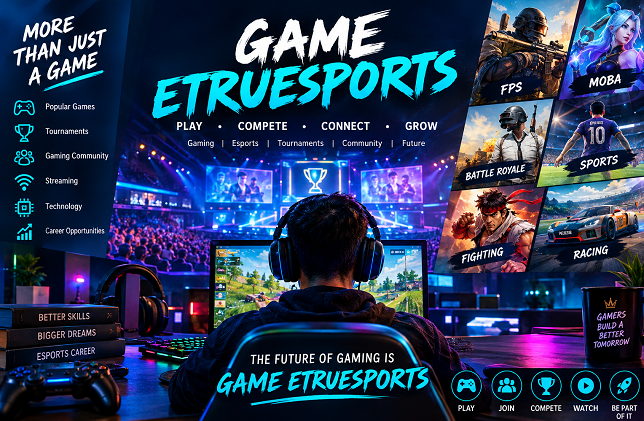

The world of gaming has changed dramatically over the last decade. What was once considered a simple form of entertainment has developed into a global digital industry involving professional competitions, streaming, online communities, advanced technology, and competitive esports. Among the many terms appearing in modern gaming discussions, game etruesports represents an interesting combination of gaming culture, esports competition, digital entertainment, and technology.
Today, gamers want more than simply playing a game. They want competitive experiences, new releases, exciting tournaments, gaming news, useful strategies, better hardware, and communities where they can connect with other players. This growing demand has helped esports become one of the most visible areas of the gaming industry.
This guide explores the meaning and importance of game etruesports, the relationship between gaming and esports, popular game categories, competitive gaming features, technology, tournaments, player development, and future trends.
Also Read: EtrueSports Tech
What Is Game EtrueSports?
Game etruesports can be understood as a broad gaming and esports concept focused on competitive digital games and the ecosystem surrounding them. It includes the games people play competitively, esports tournaments, professional players, teams, gaming communities, streaming, technology, and gaming-related content.
Competitive gaming requires more than simply understanding the basic controls of a game. Successful players usually need strategic thinking, communication, quick decision-making, teamwork, concentration, and consistent practice.
The esports environment has also created opportunities for people who may not necessarily become professional players. Coaches, tournament organisers, commentators, analysts, streamers, content creators, developers, designers, and technology companies all contribute to the wider gaming ecosystem.
Why Game EtrueSports Is Becoming Popular
One major reason for the growth of competitive gaming is accessibility. Modern games can be played on smartphones, computers, consoles, and other connected devices. This means players from different regions can participate in the same digital environment.
Online multiplayer functionality has also transformed gaming. A player no longer needs to be physically present with friends to compete. Internet connectivity allows players to form teams, enter matches, participate in tournaments, and communicate with people around the world.
Another important factor is streaming. Platforms that allow gamers to broadcast gameplay have turned gaming sessions into entertainment experiences. Viewers can watch professional matches, learn strategies, follow favourite players, and participate in online communities.
Main Types of Games in EtrueSports
The esports industry contains many different game genres. Each genre requires a different set of skills and strategies.
1. Multiplayer Online Battle Arena Games
MOBA games involve teams competing against each other while controlling characters with different abilities. Team coordination, map awareness, resource management, and strategic planning are extremely important.
Players normally have specific roles within their teams. Effective communication can determine whether a team succeeds or fails.
2. First-Person Shooter Games
FPS games focus on combat from a first-person perspective. These games often require fast reactions, accurate aiming, positioning, and communication.
Competitive FPS players spend considerable time improving their aim, movement, game knowledge, and tactical awareness.
3. Battle Royale Games
Battle royale games place multiple players or teams into a large environment where they compete to become the final survivor or surviving team.
These games combine combat with strategic decisions such as positioning, resource management, movement, and timing.
4. Sports Games
Digital versions of football, basketball, racing, and other sports have become important parts of competitive gaming.
Sports games can attract both traditional sports fans and gaming audiences because they combine familiar sporting concepts with interactive gameplay.
5. Fighting Games
Fighting games generally involve direct one-on-one competition. Players need to understand character abilities, timing, combinations, defence, spacing, and opponent behaviour.
Unlike some team-based esports, fighting games place significant emphasis on individual performance.
6. Racing Games
Competitive racing games require precision, timing, track knowledge, and vehicle control. Professional racing-game competitions can also use specialised steering wheels, pedals, and simulation equipment.
Game EtrueSports and Competitive Gaming
Competitive gaming is at the heart of the esports ecosystem. In casual gaming, players generally play for entertainment. In competitive gaming, players may participate in ranked matches, organised competitions, leagues, or tournaments.
Competition encourages players to improve their skills. Rankings and statistics can provide measurable goals, while organised tournaments give players opportunities to demonstrate their abilities.
Professional esports teams can also develop training systems. Players may practise specific maps, strategies, character combinations, or tactical situations. Teams can analyse previous matches to identify mistakes and improve future performance.
Important Skills for EtrueSports Players
Becoming a strong competitive gamer requires a combination of technical and mental abilities.
| Skill | Importance in Competitive Gaming |
|---|---|
| Reaction Time | Helps players respond quickly |
| Game Knowledge | Improves strategic decisions |
| Communication | Essential for team-based games |
| Teamwork | Helps coordinate objectives |
| Concentration | Supports consistent performance |
| Adaptability | Helps respond to opponents |
| Decision-Making | Important during critical moments |
| Practice | Builds consistency and confidence |
Technical skill is important, but knowledge and discipline can be equally valuable. A player who understands the game deeply can often make better decisions even when mechanical skills are similar.
The Role of Gaming Technology
Technology plays a major role in modern esports. High-performance computers, gaming monitors, keyboards, mice, controllers, headsets, and networking equipment can influence the gaming experience.
High-refresh-rate displays can make fast-moving gameplay appear smoother. Responsive peripherals can help players interact with games more precisely. Reliable internet connections are also important because competitive matches depend heavily on stable communication between players and servers.
Software technology is equally important. Game developers continuously release updates, balance changes, security improvements, and new content. These changes can significantly influence competitive strategies.
Game EtrueSports and Gaming Communities
Gaming communities are an important part of esports culture. Players often communicate through forums, social platforms, live streams, voice chat, and dedicated community spaces.
A strong community can help new players learn games more quickly. Experienced players can share strategies, tutorials, gameplay analysis, and recommendations.
Communities also allow fans to follow tournaments and professional players. Supporters may develop strong connections with teams and players, making esports feel similar to traditional sports fandom.
The Importance of Esports Tournaments
Tournaments provide structured competition for players and teams. They can range from small community competitions to major international events.
A typical tournament may include qualifying rounds, group stages, playoffs, and a championship final. Tournament formats vary depending on the game and organiser.
For professional players, tournaments can provide recognition and career opportunities. For fans, they create exciting events to watch and discuss.
Streaming and Game EtrueSports
Streaming has become closely connected with gaming culture. A streamer can broadcast gameplay while communicating directly with viewers.
This creates a different type of entertainment from traditional television. Viewers can interact through chat, ask questions, react to gameplay, and become part of an online community.
Competitive players can also use streaming to build personal brands. Consistent content, entertaining presentation, useful gameplay, and community engagement can help creators establish loyal audiences.
How Beginners Can Get Started
Someone interested in game etruesports does not need expensive equipment immediately. Beginners should first choose a game they genuinely enjoy.
The next step is learning the fundamentals. Players should understand the game’s objectives, controls, maps, characters, weapons, or mechanics depending on the genre.
Regular practice is more useful than random playing. A player can identify specific weaknesses and work on them individually.
Watching experienced players can also accelerate learning. Competitive matches and educational gameplay videos can demonstrate positioning, decision-making, teamwork, and advanced strategies.
Building a Competitive Gaming Routine
A good routine should balance practice with rest.
Players can divide practice into different activities. For example, one session could focus on mechanical skills, another on strategy, and another on reviewing previous matches.
Taking breaks is important. Excessive gaming without rest can reduce concentration and negatively affect performance. Sleep, physical activity, hydration, and healthy habits can contribute to better overall performance.
Game EtrueSports and the Future of Gaming
The future of game etruesports is likely to be influenced by technological development. Faster internet connections, improved hardware, cloud gaming, artificial intelligence, virtual reality, and advanced game engines could change how people play and watch competitive games.
Artificial intelligence may also become useful for training and analysis. Players could potentially use intelligent systems to review gameplay, identify mistakes, or create personalised practice exercises.
Virtual and augmented reality may provide new forms of competitive gaming. Instead of interacting primarily through traditional screens, players could experience more immersive digital environments.
Benefits of Competitive Gaming
Competitive gaming can develop several useful skills when practised responsibly.
Players may improve problem-solving, strategic thinking, communication, teamwork, and decision-making. Team-based games can encourage players to communicate clearly and coordinate their actions.
Esports can also create career opportunities. The industry requires professionals in broadcasting, marketing, event management, game development, coaching, journalism, content creation, and technology.
However, competitive gaming should remain balanced with education, work, physical activity, social relationships, and adequate rest.
Challenges in the Esports Industry
Despite its growth, esports faces challenges. Maintaining fair competition is one of the most important issues.
Cheating, unauthorised software, account security problems, harassment, and toxic behaviour can negatively affect competitive environments. Tournament organisers and game developers therefore need effective rules and security systems.
Another challenge is maintaining healthy schedules for professional players. Competitive gaming can involve long practice sessions and significant pressure. Organisations need to prioritise player well-being alongside performance.
Game EtrueSports: Gaming vs Esports
Gaming and esports are related but not identical.
Gaming is a broad term covering everything from casual mobile games to story-driven console titles. ‘Esports’ refers specifically to organised competitive gaming.
Therefore, game etruesports can be viewed as a bridge between general gaming culture and structured competitive gaming.
| Feature | General Gaming | Esports |
|---|---|---|
| Main Purpose | Entertainment | Competition and entertainment |
| Competition | Optional | Central |
| Ranking | May exist | Usually important |
| Teams | Optional | Common |
| Tournaments | Occasional | Core feature |
| Professional Players | Rare | Common |
| Streaming | Optional | Major component |
| Training | Flexible | Structured |
Why Game EtrueSports Matters to Modern Gamers
The importance of game etruesports comes from the way it connects several areas of digital culture. Gaming is no longer limited to playing a title alone. Players can watch competitions, create content, join communities, participate in tournaments, and follow professional careers.
This ecosystem provides multiple ways for people to enjoy games. Some people compete, others watch, while others create content or work behind the scenes.
As technology continues to improve, the boundaries between gaming, entertainment, sports, and online communities are likely to become increasingly connected.
(FAQs)
What does game etruesports mean?
Game etruesports can be used to describe the broader world of gaming and competitive esports, including games, tournaments, professional players, streaming, gaming technology, and online communities.
Is game etruesports only for professional players?
No. Anyone can participate in gaming and esports communities. Beginners can play casually, practise competitively, join ranked matches, or eventually enter organised tournaments.
What games are popular in esports?
Popular esports categories include FPS, MOBA, battle royale, fighting, sports, and racing games. The most popular titles can change over time depending on regions, platforms, and competitive events.
What equipment is needed for competitive gaming?
The equipment depends on the game. A suitable gaming device, reliable internet connection, responsive input device, and comfortable audio equipment are common starting points.
How can I improve my esports skills?
Start by learning the game’s fundamentals, practise specific weaknesses, watch experienced players, review your own gameplay, and develop communication and decision-making skills.
Is streaming important to esports?
Yes. Streaming helps players, teams, and creators connect with audiences. It also allows fans to watch competitions, learn strategies, and participate in gaming communities.
Can esports become a career?
Yes. Professional gaming is one possible career path, but esports also creates roles in coaching, broadcasting, content creation, event management, marketing, journalism, game development, and technology.
What is the future of game etruesports?
The future is likely to involve improved hardware, faster connectivity, AI-assisted training and analysis, cloud gaming, immersive technologies, and increasingly global competitive communities.
Conclusion
Game etruesports represents the expanding world of competitive gaming and the digital ecosystem surrounding it. From multiplayer games and professional tournaments to streaming, gaming technology, online communities, and esports careers, the industry provides many opportunities for players and fans.
For beginners, the best approach is to start with a game they enjoy, learn its fundamentals, practise consistently, and maintain a healthy balance. For experienced players, structured training, teamwork, strategy analysis, and continuous improvement can help develop competitive skills.
The future of game etruesports looks increasingly connected to emerging technologies and global digital communities. As gaming platforms become more advanced and esports audiences continue to grow, competitive gaming will remain an important part of modern digital entertainment.