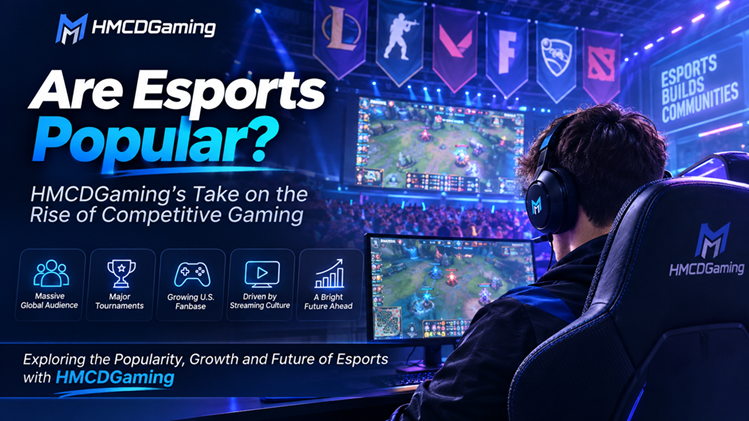

Are esports popular? In the United States and around the world, the answer is clearly yes.
Competitive gaming has grown well beyond its early roots in small online communities. Today, major tournaments draw international audiences, professional players build careers around competition, and game publishers invest heavily in organized esports ecosystems.
For anyone searching “are esports popular hmcdgaming,” the more interesting question is how esports fit into the broader gaming culture. harmonicode sports covers competitive gaming through strategy, performance, tactics, and player development. Its content explores areas such as game strategy, competitive tactics, performance, and gaming equipment.
What Are Esports?
Esports are organized video game competitions where individuals or teams compete under established rules.
That sounds simple, but the competitive structure can vary considerably from one title to another. A tactical shooter may emphasize accuracy, positioning, communication, and split-second decisions. A strategy game can demand long-term planning, resource management, map awareness, and adaptability.
Popular esports titles include:
- League of Legends
- Counter-Strike 2
- VALORANT
- Dota 2
- Fortnite
- Rocket League
- Overwatch 2
- EA Sports FC
- Mobile Legends: Bang Bang
- Call of Duty
The Entertainment Software Association describes esports as part of the broader video game ecosystem, where organized competition, communities, events, and professional participation all play a role.
One reason esports remain appealing is variety. Players do not have to enjoy the same type of competition. There are tactical shooters, battle royales, sports simulations, strategy games, and multiplayer team titles.
That diversity gives esports a much wider potential audience.
Are esports popular Hmcdgaming in the United States?
Yes, although popularity depends heavily on the game, platform, region, and audience.
The United States has one of the world’s largest gaming communities. The ESA’s 2026 research found that 212.3 million Americans play video games each week, while the average U.S. player is now 37 years old.
That demographic shift matters.
Esports are not limited to teenagers. Competitive gaming now attracts a broad mix of players and viewers, including:
- Teenagers discovering competitive games
- College students joining esports clubs
- Young adults following professional teams
- Long-time gamers watching major tournaments
- Casual players who become fans through streaming
- Traditional sports fans exploring competitive gaming
There is also an important distinction between gaming and esports.
Someone might play Fortnite every week without watching professional Fortnite competitions. Another person may regularly watch League of Legends tournaments without playing the game themselves.
For that reason, esports popularity cannot be measured by player numbers alone. Viewership, tournament attendance, streaming audiences, participation, community engagement, and professional activity all provide useful pieces of the picture.
Why Are Esports So Popular?
Several forces have helped competitive gaming develop into a major entertainment category.
Easy Access to Competition
Traditional sports often require a physical venue, specialized equipment, or an organized local league.
Esports can begin with a computer, console, or mobile device and an internet connection. Players can practice from home and compete against opponents across the country—or across the world.
That accessibility makes competitive gaming unusually easy to enter.
Streaming Changed How Fans Watch
Streaming has transformed esports viewing.
Fans no longer need to attend an arena or wait for a television broadcast. They can watch tournaments from a phone, laptop, gaming monitor, or television.
Streaming also creates a closer connection between players and their audiences. A professional competitor can compete in a tournament, stream practice sessions, create videos, and interact directly with fans.
That crossover gives esports a community-driven quality that traditional sports do not always provide.
HMCDGaming and the Competitive Gaming Conversation
HMCDGaming approaches gaming from a performance-oriented perspective.
Its published material covers areas such as game strategy breakdowns, competitive tactics, performance insights, and sports gear optimization. The site’s esports guide also discusses strategic thinking, physical preparation, and mental performance.
That broader approach reflects an important reality about competitive gaming: mechanical ability is only part of the equation.
A strong player also needs to understand:
- Map positioning
- Team communication
- Opponent tendencies
- Game economy
- Timing
- Decision-making
- Practice structure
- Mental discipline
- Hardware and settings
- Recovery during long sessions
In other words, winning consistently requires more than simply playing for hours.
How Big Is the U.S. Gaming Market?: Are esports popular Hmcdgaming
The size of America’s overall gaming industry provides useful context for the esports conversation.
The ESA reported that U.S. consumers spent approximately $60.7 billion on video games during 2025. Content represented the largest share of that spending, followed by hardware and accessories.
The industry also supports a substantial economic footprint.
According to the ESA, the U.S. video game industry supports more than 250,000 jobs and contributes approximately $95.8 billion in total economic impact.
Esports represent only one part of that market. Still, the surrounding ecosystem creates opportunities for competitive gaming.
Game publishers, hardware manufacturers, streaming platforms, tournament organizers, advertisers, professional teams, and content creators all contribute to the broader industry.
That interconnected ecosystem gives esports room to grow.
Popular Esports Games Compared: Are esports popular Hmcdgaming
| Game | Competitive Style | Core Skills | Audience Appeal |
|---|---|---|---|
| League of Legends | Team strategy | Coordination, macro play, mechanics | Global esports audience |
| VALORANT | Tactical shooter | Aim, communication, strategy | FPS and tactical fans |
| Counter-Strike 2 | Tactical FPS | Precision, positioning, economy | Competitive FPS audience |
| Dota 2 | Strategy MOBA | Decision-making, teamwork | Strategy-focused fans |
| Fortnite | Battle royale | Building, aim, positioning | Broad gaming audience |
| Rocket League | Sports/action | Mechanics, timing, teamwork | Sports and gaming crossover |
| EA Sports FC | Sports simulation | Tactics, reactions, mechanics | Soccer fans |
| Mobile Legends | Mobile MOBA | Strategy, teamwork, mechanics | Mobile gaming audience |
There is no permanent ranking of the world’s most popular esports games.
Audience size can change from one year to another. Tournament formats, publisher decisions, regional preferences, new releases, and player interest can all influence a game’s competitive position.
That makes esports a constantly shifting landscape.
Esports vs. Traditional Sports: Are esports popular Hmcdgaming
Esports and traditional sports operate in very different environments, but their competitive structures share several similarities.
| Factor | Esports | Traditional Sports |
|---|---|---|
| Competition | Digital games | Physical sports |
| Training | Mechanics, strategy, analysis | Physical and tactical training |
| Teams | Structured teams | Structured teams |
| Coaching | Strategy and performance | Strategy and physical performance |
| Fans | Streams, events, social media | TV, streaming, stadiums |
| Careers | Players, coaches, creators | Players, coaches, analysts |
| Equipment | PCs, consoles, peripherals | Sport-specific equipment |
| Competition | Often global and online | Often organized through leagues |
The biggest difference is obvious: esports take place digitally.
Competitive gaming does not demand the same physical abilities as football, basketball, baseball, or hockey. However, that does not mean esports require no physical or mental preparation.
Players need concentration, hand-eye coordination, reaction control, endurance, and the ability to make decisions under pressure.
Those demands become increasingly important at the professional level.
Practice Matters More Than Hours Played: Are esports popular Hmcdgaming
Simply spending more time in a game does not guarantee improvement.
Effective practice needs structure.
A competitive player might divide a training session into several stages.
Warm-up: Spend 10 to 15 minutes practicing basic mechanics.
Skill work: Focus on one specific area, such as aim, movement, combos, building, or another game-specific mechanic.
Competitive matches: Test those skills against real opponents.
Review: Look back at mistakes instead of immediately starting another match.
Adjustment: Choose one weakness to address during the next practice session.
This approach turns gaming time into deliberate practice.
HMCDGaming’s performance-focused approach supports a similar principle: competitive improvement involves strategy, preparation, mental discipline, and physical considerations rather than raw playtime alone.
Pros and Cons of Esports: Are esports popular Hmcdgaming
Pros
- Creates competitive opportunities for gamers
- Connects international communities
- Encourages teamwork and communication
- Provides professional and creative career opportunities
- Develops strategic thinking
- Creates opportunities for coaching and analysis
- Makes organized competition accessible online
- Supports large communities around individual games
Cons
- Long sessions can cause physical strain
- Competition can create significant stress
- Online communities may involve toxic behavior
- Professional careers are extremely competitive
- Player income can be unpredictable
- Frequent game updates can change established strategies
- Heavy competition can contribute to burnout
The key is balance.
A serious player should not sacrifice sleep, education, work, exercise, or relationships simply to increase practice hours.
Expert Tips for Aspiring Esports Players: Are esports popular Hmcdgaming
Choose One Primary Game
Trying to master several competitive titles at once can slow progress.
Choose one primary game and learn its mechanics, strategies, maps, and competitive systems thoroughly.
Study High-Level Players
Do not watch professional matches only for entertainment.
Pay attention to positioning, timing, rotations, communication, resource management, and decision-making.
Ask yourself why a player made a particular move.
Track Your Mistakes
Keep a basic practice journal.
Write down recurring problems such as poor positioning, missed shots, weak communication, rushed decisions, or inefficient resource use.
Patterns become easier to fix when you can see them clearly.
Are Esports Becoming More Mainstream?: Are esports popular Hmcdgaming
There is strong evidence that competitive gaming continues to gain institutional recognition.
The International Olympic Committee has moved toward an Olympic Esports Games, with the inaugural edition planned for 2027. Esports have also appeared as a medal event at the Asian Games.
That does not mean esports have reached the same cultural position as the NFL or NBA in America.
They have not.
Instead, esports have developed their own space at the intersection of gaming, technology, entertainment, streaming, and organized competition.
That distinction matters. Esports do not need to copy traditional sports to become successful.
What Could Shape the Future of Esports?: Are esports popular Hmcdgaming
Several developments could influence competitive gaming over the next few years.
Mobile Esports
Mobile competition can reach players who do not own high-end gaming PCs or consoles.
That accessibility gives mobile esports considerable potential, particularly in markets where smartphones represent the primary gaming device.
More Sophisticated Broadcasts
Tournament broadcasts continue to improve.
Live statistics, player perspectives, replays, overlays, and other presentation tools can make complex games easier for new viewers to follow.
Better broadcasts can also make competitions more appealing to people who have never played the game themselves.
College Esports
Universities and colleges can provide organized environments for competitive gamers.
These programs can combine competition with education, community, scholarships, and potential career opportunities.
Greater Attention to Player Health
Professional organizations have strong reasons to take player health seriously.
Training schedules, recovery, ergonomics, physical activity, sleep, and mental performance can all influence consistency.
The most sustainable competitive careers will likely place greater emphasis on long-term player well-being.
(FAQs) About Are esports popular Hmcdgaming
1. Are esports popular in the United States?
Yes. Esports have a substantial U.S. audience, supported by the country’s enormous gaming population. The ESA reported that 212.3 million Americans play video games each week in 2026.
2. Is HMCDGaming an esports game?
No. HMCDGaming is a gaming-focused website and content brand. Its material covers competitive gaming, strategy, performance, and related topics.
3. Why are esports so popular?
Accessibility, streaming, competition, online communities, professional players, and major tournaments have all helped esports attract large audiences.
4. What is the most popular esports game?
There is no single permanent answer. Popularity changes by region, platform, tournament, and measurement method. League of Legends, Counter-Strike 2, VALORANT, Dota 2, Fortnite, and several mobile titles all have strong competitive communities.
5. Can esports be considered a real sport?
Esports share several characteristics with traditional sports, including organized competition, teams, coaching, training, professional leagues, and dedicated fans. However, esports differ because the competition takes place digitally.
Conclusion: Are esports popular Hmcdgaming
So, are esports popular? Yes—but the answer becomes more meaningful when you look beyond tournament viewership.
Esports have become an established part of the broader gaming ecosystem. The United States alone has an enormous gaming audience, with more than 212 million people playing video games every week, according to the ESA’s 2026 research.
Competitive gaming gives that audience another way to engage with games. Players can compete. Fans can follow professional teams. Creators can build communities. Publishers can develop organized competitive ecosystems.